
According to the Department of Pharmaceuticals' annual report for 2024-25, India imported medical devices worth $8.1 billion, while exports stood at $3.7 billion in the financial year 2023-24 (FY24)

'They are totally disconnected with farm activities which their families have been involved in for years.'

You have to grow, and grow fast - that's the DNA of the JSW group, chairman Sajjan Jindal said as JSW Cement made its debut on the stock market mid-August. The remark captured not just the moment but also the momentum of JSW's growth story.

'Developers have started offering 70% to 100% extra area and beyond.' 'If the market cycle shifts -- as many are already predicting with signs of price saturation and reduction -- most recent redevelopment projects will unravel.'

'It is good to have the H1-B visa option but if tomorrow things happen to change, it is not the end of the world situation.'

More than 7,700 senior professionals with over 15 years of experience have exited India's IT services firms -- TCS, Infosys, Wipro, HCLTech, Tech Mahindra, Cognizant, and LTIMindtree -- over the past 12 months.

'The kids are already used to this place. We go back and that's a different environment.' 'So, mentally, emotionally we are stressed.'

'Attacks on nuclear sites pose significant threats.'

The Indian AI market is expected to grow to over $17 billion by 2027, more than tripling its current size, driven by increased investments in enterprise technology, a flourishing digital ecosystem, and a strong pool of skilled professionals, according to BCG.

'If Washington has to balance Chinese power, she will have to turn to the third biggest power in the world which is India.' 'The United States and India will have to work together in order to keep Chinese ambitions in check.'

India's largest IT services company TCS believes that generative artificial intelligence (AI) is not just another tech cycle but a "civilisational shift" which will positively benefit every industry.

Vice Admiral Li Hanjun, chief of staff of the People's Liberation Army Navy (PLAN), and Liu Shipeng, deputy chief engineer of China National Nuclear Corporation, have been expelled from the National People's Congress (NPC), the Hong Kong-based South China Morning Post reported.

Mutual funds (MFs) have significantly increased their ownership across market segments, but the midcap space stands out with comparatively higher growth. Data reveals that the number of midcap companies with over a fifth of MF ownership has doubled from nine in March 2022 to 18 by March 2025. In contrast, largecap stocks saw only a marginal rise, from three to four such companies during the same period.

A Reuters report stated that the high-profile meeting reflects Ambani's growing influence in global business and diplomacy. Over the years, Qatar Investment Authority (QIA), the country's sovereign wealth fund, has invested in several Reliance ventures.

Fuelled by the global capability centre (GCC) boom, gross leasing of office space across top eight cities soared 5 per cent to touch 21.4 million square feet (msf) in the second quarter of calendar year 2025, according to Cushman & Wakefield's Q2 India Office Market report.

Dining today isn't just about food -- it's about the experience and the story.

'The startup ecosystem, the government, and the owners of large pools of Indian capital need to actively support the creation of these local champions, not pull down the teams that are trying hard to get there.'

'As more and more work becomes automated and a range of lower-level and higher-level tasks are replaced by AI, the need for a classic command-and-control pyramid structure goes away.'
Several multinational medical device makers are focusing on deepening their presence in India by expanding their local manufacturing footprint and research capabilities, a move that can catapult India into a strategic hub for the medical technology (medtech) industry. Among those increasing their reach in the country are Siemens Healthineers and Philips, signalling a broader shift from India being only a sales destination to becoming a global production and innovation base.


Bessemer Venture Partners has closed $350 million in capital for its second dedicated India fund to back founders in the region, who build enduring companies.
US-based Citigroup is likely to allocate more global roles to India than to any other centre it operates in due to the country's strong talent pool, said Jane Fraser, chief executive officer of Citigroup, on Wednesday in an interaction with CNBC-TV18. Fraser also expressed confidence that India will remain the world's fastest-growing economy.

India's flexible (flex) office segment, having breached pre-pandemic levels, is thriving as corporates, startups, multinational corporations, and global capability centres (GCCs) expand in India, seeking low-capital yet Grade A plug-and-play facilities. In the first quarter (Q1) of 2025, the flex office segment continued to grow, with flex space leasing rising by 22 per cent to 2.2 million square feet (msf), according to Colliers.

Export-led Indian IT sector is not directly hit by Trump's tariff order on goods, but there could be worrisome indirect bearings on it arising out of possible slowdown in decision-making and GDP growth in America over higher tariffs, which may then cloud demand from specific verticals, according to some analysts.
While advancements in biotechnology hold immense promise for health and innovation, they also come with significant risks if misused.

Employers in India are planning to outpace global adoption in certain future technologies as companies operating in the country are heavily investing in technologies like artificial intelligence (AI), energy technologies, robotics, and autonomous systems, said the World Economic Forum (WEF) in its latest "Future of Jobs" report released on Wednesday. The report, released days before the WEF annual meeting in Davos from January 20-25, notes that 35 per cent employers in India think that adopting semiconductors and computing technologies (compared to 20 per cent globally) will transform their operations while 21 per cent employers think that adopting quantum and encryption technologies (compared to 12 per cent globally) will also transform their operations.

Isn't there something significant in the UPI example for all of us to learn from and execute to enable world-scale success for our startups?, asks Ajit Balakrishnan.

The fees charged by investment banks to manage initial public offerings (IPOs) have increased to an average 3.23 per cent of the issue size this calendar year, the highest since 2020. The average fee is up 8 per cent compared to last year, when it stood at 2.99 per cent. The investment banking fees have increased as the average IPO size has shrunk this year.

There's clearly no limit to how dramatic a wedding can be.

'The answer is not for me to give. The answer either way has to be heard from the industry itself. Tell us why not if you are not doing it; tell us if you are doing it -- why should this question remain unanswered?'

'MNCs now recognise India's capacity for innovation and its pivotal role in substantive contributions to global product development.'
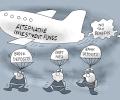
Alternative investment funds (AIFs) - investment vehicles favoured by the affluent - have topped $50 billion (Rs 4.3 trillion) in total investments for the first time during the April-June quarter, according to the latest data from the Securities and Exchange Board of India. The industry's commitments have approached Rs 12 trillion ($140 billion), marking a 40 per cent increase over the past year. The amount raised and deployed stood at Rs 4.74 trillion ($56 billion) and Rs 4.32 trillion ($51 billion), respectively, the data shows.
Alternative investment funds (AIFs) have crossed Rs 5 trillion in terms of funds raised, while the investment commitments have surpassed Rs 12 trillion for the first time as of September, according to data released by the Securities and Exchange Board of India (Sebi).

In 2024, the Securities and Exchange Board of India (Sebi) implemented significant reforms, focusing on cooling down the derivatives segment, enhancing transparency and accountability in small and midsised enterprise (SME) listings, and deepening the fund management ecosystem.

MNC funds invest in companies where foreign promoters have more than 50 per cent shareholding.

Why did the political system in the country react to these two decisions of the Modi government in a diametrically opposite manner? asks A K Bhattacharya.

With its age-old fascination for education, southern states have done better than the North. Start-ups, IT hubs, and industry majors setting up shop have changed the face of the South. Nearly 79% of global offices set up by international conglomerates in India are in the South. Almost 46% of tech unicorns are from the South. The GDP per person in the South is 4.2 times higher than the North. None of these indicators can be ignored by any central government, whatever the political compulsions, notes Ramesh Menon.

If the concerns over risking political capital are overcome, the long-term gains for the Indian economy will be immense, asserts A K Bhattacharya.

Prior to the attack, the size of the pool was around Rs1,400 crore.

Tesla owner billionaire Elon Musk and Indian American entrepreneur Vivek Ramaswamy in an op-ed provided an insight into their blueprint for an unprecedented government reform that includes mass federal job cuts and massive expense reduction.
 © 2026 Rediff.com - Advertise with us - Disclaimer - Privacy Policy - Sitemap - Feedback - About us - Terms of use - Grievances